Tuesday, 15 January 2008

Fluff

Photobucket

Apparently, no-one in the UK uses ironing aids. Not that I'm one to speak, it's taken me more than two years to notice this fact.

After a wonderful tip from a fellow weaver suggesting using ironing aids to limit the amount of fluffing the linen is doing, I went hunting for some last Friday. It took much more effort than I had thought it was going to. I finally managed to track down one product that was silicon-based. Knowing how effectively the silicon-based hair serum I use to turn the frizz on my head into something resembling hair works, I decided to try it...and it's amazingly effective. I've been spraying it on the warp threads just as they come off the back beam every time I wind on (this means I can keep weaving as it's dry by the time it gets to the heddles), with only the occasional additional spray behind the reed when required. It's reduced by hundreds the number of large fluff balls attached to warp threads and taken the clearing of fluff balls from the threads from a constant necessity to an occasional task. Even better - contrary to my expectations, I've still not had a single broken warp thread, and there are only two stretched warp threads in the back as opposed to the dozens I had before. Because of this, I must have managed to weave well over a metre of cloth over the weekend.

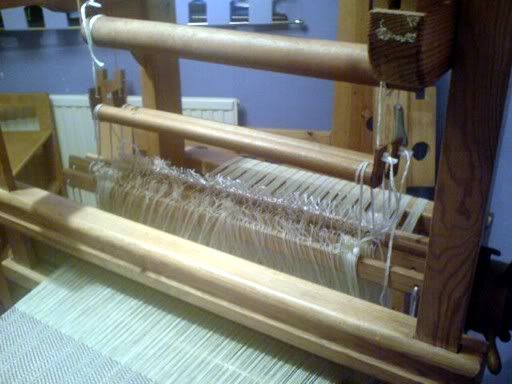
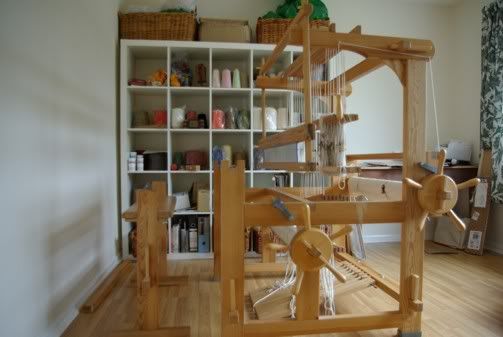
As you can see by the photo above though, there's still a lot of fluff accumulating below the loom! I'm sure it's all going to gather and rise up at any moment, and I'm going to find that I have a pet husky I wasn't expecting.

Tuesday, 8 January 2008

Onward with the linen: sampling

All those brave words I typed about taking the irregularities in the linen as evidence of the rusticality of the piece, and being able to live with the threading errors? I really ought to know myself better. After weaving 8-9 inches of the linen, I stopped to assess. And discovered that the two places where I had missed a dent in the reed when sleying both had a threading error with two threads in the same dent, right beside them. Aaah. You can see this in the picture below, marked with purple threads:

Photobucket

In addition to this, I wasn't happy with the balance of the loom for the plain weave. A very broad cloth of plain weave is a most unforgiving thing to weave - all errors stand out like a sore thumb. So I decided that this was the perfect time to cut off the first section and use it as a sample. In doing so, I fixed the sleying errors, rebalanced the loom and retied the warp. I'm really pleased with the way the linen yardage feels after coming off the loom. It's a nice firm fabric despite being an open weave, and will do well for cross-stitch, I think. The next step is to zig zag the ends, wash it and use it for a sample sewing piece. In the meantime I'll get on with the rest of the yardage.

Now to illustrate exactly why you shouldn't weave with a fluffy single as a warp, this is what happens behind my reed as I beat:

Photobucket

Don't you envy me the job of clearing that off each of the 700 threads after every few beats?

Wednesday, 2 January 2008

Linen cloth for cross-stitch

I lived the life of a retiree over the break, pottering around with my partner, taking lots of long country rambles, and spending a lot of time in the garden pulling out the ivy that has overgrown it during years of neglect, so I can make a garden when I get back in spring. That has meant, of course, that very little was done on the weaving front. However I did prove that it is possible to warp using a sticky single without tangles after all (using my back-to-front-to-back technique), and after readjusting the tension on the front of the loom, weaving commenced.

Photobucket


I've woven a bit over 6 inches so far. It's quite a change for me to go from weaving small items with complex weave structures to a large piece of plain yardage. I've not found throwing the shuttle the extra length to be a problem, in terms of width or maintaining an even tension, which is good, as I have a couple of larger project in mind for the future.

Weaving linen for cross-stitch is hardly a complex weave as it's a simple balanced, slightly open plain weave, but it is extremely useful for highlighting any errors that occur in selvedges and weaves. I've had no problem with the selveges, but the weaving itself has been slow going. I've completely gone against the advice I always give novices and I'm not only weaving with a single warp, but I'm weaving with a fluffy one. This makes weaving very slow, as I'm also weaving with a 20-dent reed. every few picks I have to stop and clear slubs of fluff that have formed on the warp, which is very good at developing patience. If I miss one, I risk stretching an individual warp thread which ruins the evenness of the tension across the threads. This has been happening quite a bit despite my care, so the back of my loom is starting to look like an odds and ends store.

Photobucket

Old watches, bracelets, little jars, anything that is the right weight are being employed. I really must try to buy some fisherman's lead weights, I think!

The result of this is that occasionally a thread isn't shedding properly, and a thread will be skipped, resulting in a float.

Photobucket

Rather than try to fix this, I've made the command decision that it will make little difference once it's sewn over anyway, and it will add to the slightly rustic, antique feel of the piece. It's great when you can explain away all errors so easily! I've found that as the warp is stretching so much, it helps to take a leaf from the book of beaming, and go to the back of the loom and tug on the warp thread every so often, to even out the tension. It's been working:

Photobucket

It's not the relaxing weaving I was expecting it to be because of the difficult warp, but I'm pleased that I'm able to surmount those difficulties. I really shouldn't say it because I'm expecting one at any moment, but I've not had a broken warp thread....yet!


Now is really the time that I need to be deciding what to do next, and I'm undecided. I've threaded this current project with a straight threading on all eight shafts, so if I choose the right project I can just tie the next warp on. I could do a few more scarves, or a baby's blanket for some friends who are expecting. Or I may try to take on a couple of experimental samples that have been floating around in my head....I'm thinking of playing with something like Swedish flessbergplegg.

Thursday, 13 December 2007

Making linen cloth

I gave up cross-stitch years and years ago when I realised that although I stiched obsessively, I only ever put one project I'd completed on display. That I was more interested in the process than in owning something that was pretty but not practical. When I moved to the UK from Australia, my ex-husband asked me if he could keep that one project on display: a rather lovely large cross-stitch I had done, because he was attached to it. I agreed, deciding that I could make another for myself. But I had a problem finding a suitable linen fabric for it, until I realised that since the last time (years ago) that I did a cross-stitch, I had developed the technology to make my own. To make linen suitable for this project all I needed was a plain-weave fabric, set at 20 epi. I have absolutely ~~no~~ idea why it took me so long to make the connection.

Consequently, a week or so ago, I spent an entire evening in front of the television, warping 4 km of linen around a warping board. My thoughts were of two things as my side and arms ached from swaying from side to side over the warping board: the first was vaguely wondering why at times I think that this is an interesting, rewarding hobby. The second was that I really, really want a warping mill because it's easier and because I only have the capacity to wind 5 metre warps at the moment and that's not enough. I've had enough of playing with different types of yarn now and want to start working on multiple possiblities and projects from a single warp. Hence winding a 5 metre warp of linen when I only want to make 1.5 metres of fabric for the cross-stitch project.

The linen is a lovely natural, slightly rough 6/1 linen, so it should give a nice natural, antique feel. Yes, I know I swore I'd never warp with a single yarn again the last time I did it, but I thought I'd perservere and try again. All of the linen I have is singles, and I thought it would be a chance to work on my technique of warping with singles.

Anyway, in case you were wondering what 4 kilometres of linen looks like...it looks like this:

Photo Sharing and Video Hosting at Photobucket

That's four groups of 120 ends and two groups of 110 ends, to give 700 ends in total. This means I'm finally going to use my loom to its full width. I tend not to chain my warps, particularly a springy single, because I find winding them around something handy like a shuttle keeps them under more tension and less likely to tangle.

I use a warping technique I've devised myself for difficult warps such as sticky yarns or singles, which could probably be summarised as a back-to-front-to-back warping technique. I find it reduces my errors and makes any easier to find while they're still easily corrected before weaving starts.

First, I tie the object the warp is held to to above the back beam, and insert the cross into lease sticks suspended from the castle.
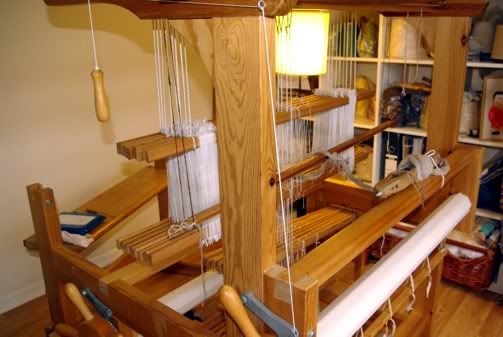
Photo Sharing and Video Hosting at Photobucket

Then I move to the front of the loom remove the beater holding the reed, and thread the heddles from the front.
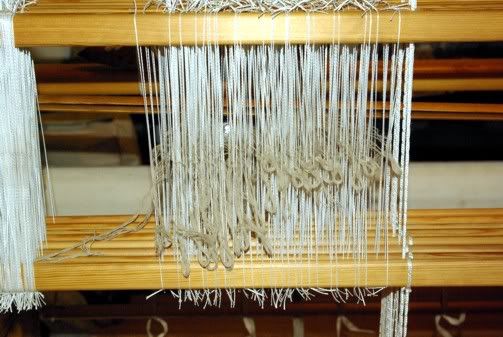
Photo Sharing and Video Hosting at Photobucket

I do this for all the threads and then replace the beater and sley the reed. (You're about to see a magical change of warp here). I then tie the warp to the front apron rod:
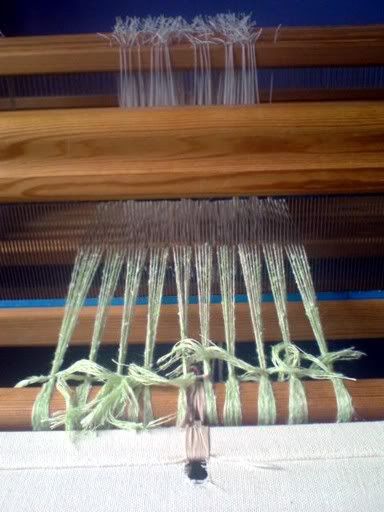
Photo Sharing and Video Hosting at Photobucket

Sometimes I spread the warp into a raddle on the back beam at this stage but it's not really necessary unless the warp is really difficult, because the heddles will space the warp nicely anyway. To keep the warp under tension while I'm beaming on to the front beam, I use a water bottle technique. I keep four half-kilo plastic rice jars with handles on the lids for this purpose (I tie a loop of yarn to the handles). I tie a loose overhand knot in the warp, halfway to the floor, and slip the yarn attched to the handle of the water-filled rice jar over that knot. It feels as though the knot would slip at first but it never does. The following pictures illustrate this concept:
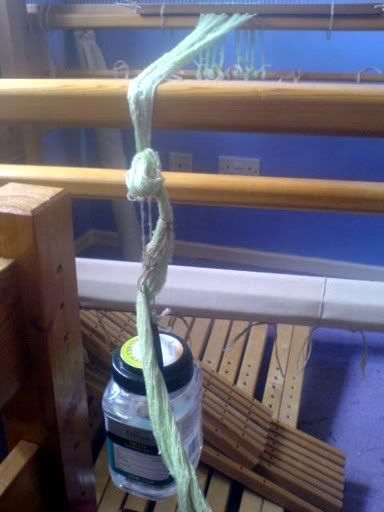
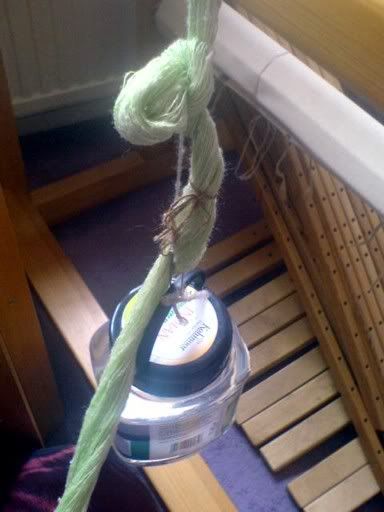
Photo Sharing and Video Hosting at Photobucket Photo Sharing and Video Hosting at Photobucket

As the water bottles get up near the back beam, I remove them, untie the knot and retire it a little further along the warp. I run my fingers gently through the warp each time I move the knot, to make sure that the warp threads are all more or less in the place they should be. Also as I'm winding on to the front beam, I stand at the side of the loom and watch the heddles. If there are any crossed warps trying to go through a heddle, the heddles will draw forward. You can stop and fix any tangles before they're a problem. I stop and check every revolution or so of the front beam anyway, to make sure that tangles aren't occurring. I also put the occasional warp stick between the layers of warp to make sure it can't get caught up.

One the warp is entirely on the front beam, I bring the back apron rod up and tie the warp to that and check the tension until it's even. Then I wind the warp back onto the back beam, adding warp sticks at intervals. This step is very fast and there shouldn't be any need to watch for snags at this stage as you've already found them. When the warp is all on the back beam, recheck the tension on the front apron rod and you're ready to weave, safe in the knowledge that you have no crossed threads to worry about.

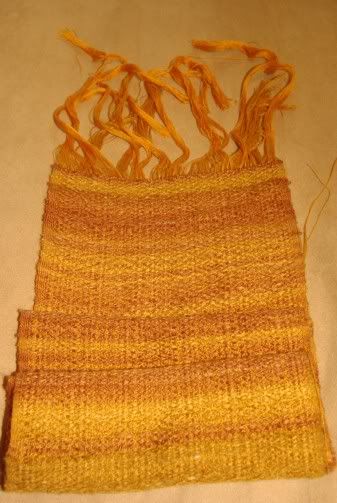
The brown and yellow silk scarf

This scarf was woven with a golden yellow 60/2 silk warp, set at 30 epi. The weft was the hand-dyed, handspun silk cap in browns and yellows which was part of the series of silk caps I've been playing with lately. This was pleasantly easy to weave, despite some early issues with breakages along the selvedges - you can see a couple of loose warp threads at the sides where I've had to reattach broken warp threads. I've learned a lot about how such fine silk deals with sett and friction at the outside of the reed with this project.

Photo Sharing and Video Hosting at Photobucket


The draft was basically an overshot I designed myself using the draft software at handweaving.net. I put a thin border of plain weave six thread wide on each of the selvedges, which did result in a tension difference as I wove further down the warp. This was fixed by hanging scissors from the looser selvedge thread groups.

A close-up of the weave structure:

Photo Sharing and Video Hosting at Photobucket

This has turned into quite a short scarf because the silk packed more tightly into the 60/2 silk than it does into thicker warps. But the end result is so luxurious it's going to be repeated.

Tea cloths

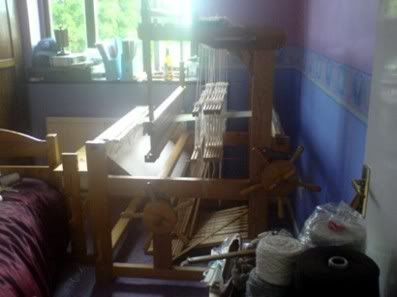
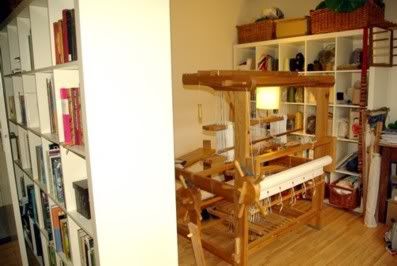
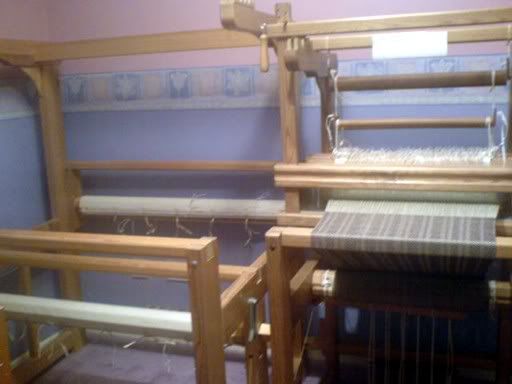
This is what my mediaeval torture chamber weaving studio used to look like...and what it looks today. What a difference!

Photo Sharing and Video Hosting at Photobucket Photo Sharing and Video Hosting at Photobucket

I've put the closer bookcase beside the door, so it makes a kind of corridor into the room. This allows me to access that bookcase from both sides (and gives me space for all of my books), and gives the loom a kind of nest in which to live. This was C's suggestion, and it works really well. I've left a couple of spaces free except for an ornament, which allows one to see through to me weaving if walking into the room.

I really need to document more of my planning process becasue I spend so much time thinking about weaving theory, and yet this seems to be a blog of finished items.


Going back through some old photos, I decided to document the teatowels I made before buying my new loom. It was my first attempt at a real yardage, working with 10/2 cotton, as normally I'd play with finer, more exotic fibres.

Photo Sharing and Video Hosting at Photobucket

The warp was 5 metres of 10/2 cotton in natural, set to 24 epi. I ran it the with of that loom...about 12-14 inches, from memory. The warp was a chocolate 10/2 cotton, and the draft was a modification I'd made from the background of a classic old American draft which came from an old weaving book which had belonged to a friend's grandmother and gifted to me.

The old loom looked so tiny beside the new loom. I was amazed by hwo quickly you can weave 5 metres of cloth when you're working with 10/2 cottons.

Photo Sharing and Video Hosting at Photobucket

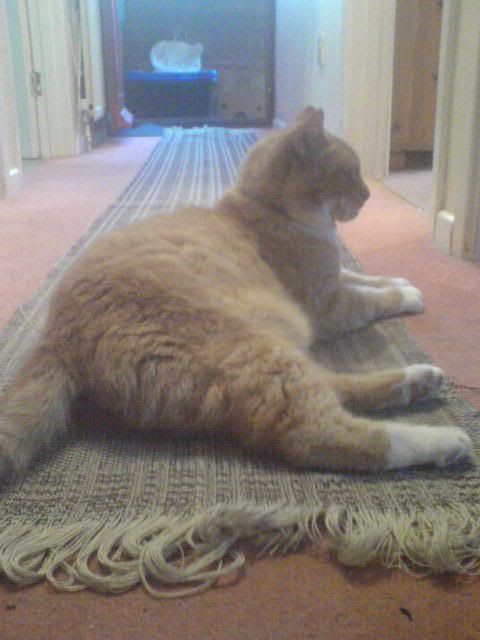
When pulled off the loom, the warp ran the entire length of my hall at the time. I also learned that a previously unsuspected hazard of laying recently woven fabric on the floor is that approximately 15 seconds after it is put there and while you're rummaging around to find your camera, the neighbour's cat will appear out of nowhere, walk from one end to the other of it, and flop on top of it as though it owns the house and it's been there all it's life:

Photo Sharing and Video Hosting at Photobucket

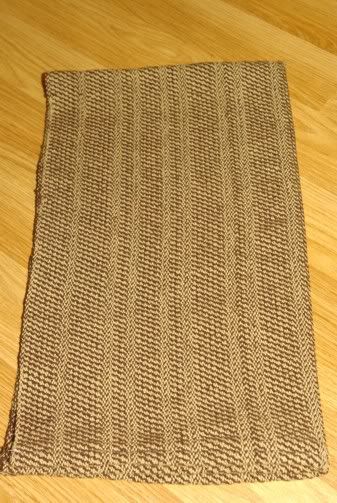
I got four teatowels from the fabric, after finishing, removing ginger hairs and washing. I simply cut the fabric and hemmed the ends. The result is luxuriously thick teatowels which are much superior to those bought in stores. These ones now live in my kitchen but I'm thinking of making some to sell.

Photo Sharing and Video Hosting at Photobucket

I may never buy a teatowel again.

Thursday, 29 November 2007

The sunset scarf

You know you're serious about your weaving when you move house so you can have a dedicated weaving room. From the cramped corner of the spare room in my previous flat, I now have this:

Photo Sharing and Video Hosting at Photobucket

That's an image of my weaving studio as I was rebuilding my loom. What I can't believe is how I got that huge loom into the corner of the tiny spare room in the old house. It dominates this room! But at least I have my stash out on display so I can remember what's there and gain inspiration from it as I weave. The loom is now flanked by two of those sets of shelves. The second sits between the door and the loom, giving it its own little alcove and providing me with not only space for all of my books but also more storage space. Heaven.


I finished the cashmere and handspun silk scarf before moving.

Photo Sharing and Video Hosting at Photobucket

Despite being convinced that I never want to try warping with soft 1/10 yarn again, the scarf itself was lovely - and the weave really did look like little licks of flame.

Photo Sharing and Video Hosting at Photobucket

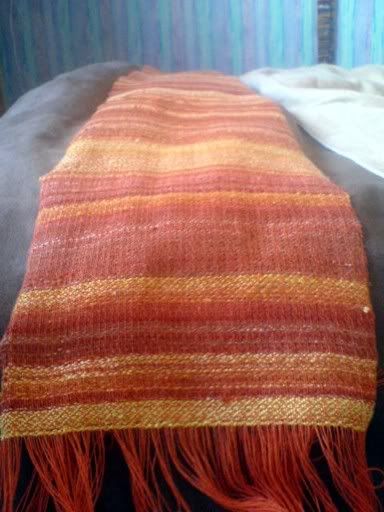
This is it, off the loom, but before fringing:

Photo Sharing and Video Hosting at Photobucket

As the draft was based on a twill and the cashmere was so soft, I was expecting this fabric to have a real drape when it came off the loom. I was surprised to find that it actually ended up being a quite crisp fabric, certainly as crisp as the plain-weave, all-silk 'Apple orchard' scarf that I made. Lovely all the same, but not what was expected, and I'm not entirely sure why yet. It may be that it's a result of the handwoven raw silk cap. I have another scarf on the loom at the moment which will mix the handspun browns I mentioned in the previous post with yellow 2/60 silk. That will come off the loom soon, and I'll know then whether that's the case. That scarf deserves a post all of its own - I've been learning how to handle 2/60 silk on this loom.


Now, in order to finish the flame scarf, I just have to figure out where it crawled off to hide in the process of unpacking in the new house....